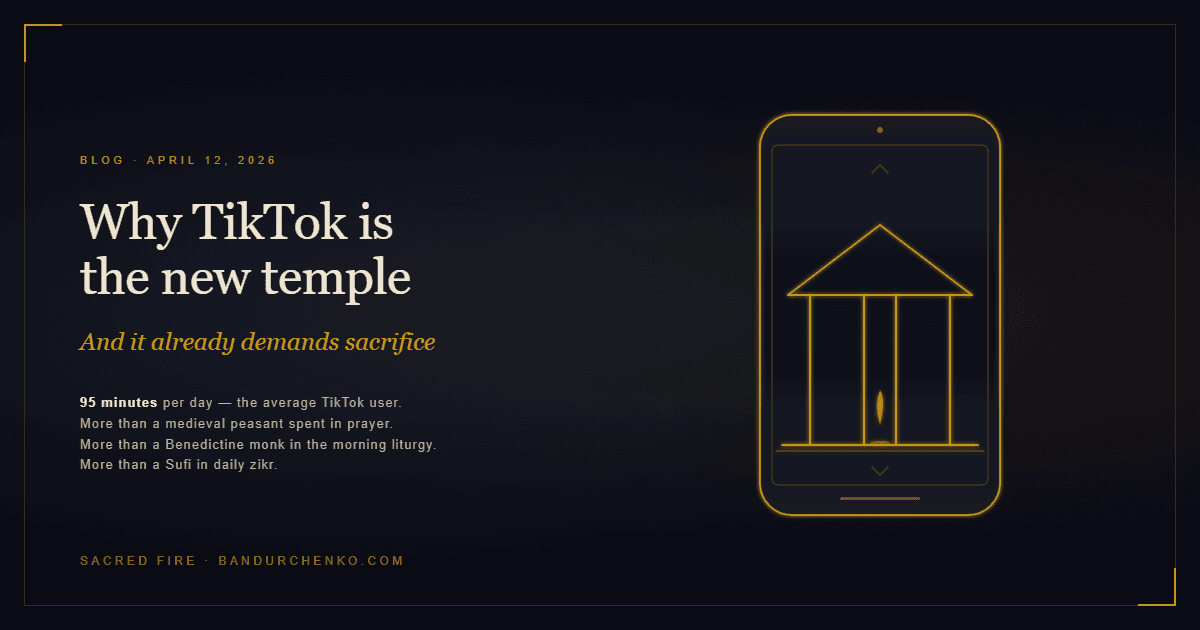
In 2024 the average TikTok user spent 95 minutes a day inside the app. That is more than a medieval peasant spent in prayer. More than a Benedictine monk spent at morning liturgy. More than a Sufi spent on the daily zikr.
We don't notice this because we've been trained to think "religion" means a building with a dome, a bearded man at a pulpit, and candles. But strip away the decor and look at the mechanics — at what the system *does* to a human being, not what it calls itself — and the picture flips.
What does a temple do?
A temple does three things. It captures attention — pulls you out of the ordinary world into a space where different rules apply. It rewires the brain's predictive model — changes what you consider normal, important, desirable. And it gets you to pour your life-energy into building a macro-system larger than yourself.
The Sumerian Ziggurat did this through the ritual of sacred marriage at its summit. The Eleusinian mysteries did it through nine days of preparation and one night in the Telesterion, after which a person walked out different. The charismatic church does it through two hours of singing, until the wave rolls through your body and you go down.
TikTok does the same thing. Only more efficiently.
The mechanics of capture
The TikTok Algorithm is not just "a feed of short videos." It is a self-learning system that, within forty minutes of use, builds a precise model of your dopamine triggers. It knows which frame will hold your gaze. It knows which music will give you chills. It knows when to throw in something new and when to repeat a familiar pattern.
Sumerian priestesses spent years learning to read a crowd. The Algorithm does it in forty minutes. And it does it to a billion users simultaneously.
The result is the same: an altered state of consciousness. Time disappears. Critical thinking switches off. The Default Mode Network — the brain circuitry responsible for the "I," for reflection, for the ability to see yourself from the outside — goes dark. Only the flow remains.
Any mystic would recognize this state. It is what people meditate for hours to reach. What dervishes whirl for. What tantrikas hold their breath for.
Except the mystic enters it deliberately. The TikTok user does not.
A God that doesn't call itself a God
Here is what makes the Algorithm a genuinely new species of God: it doesn't demand belief. It doesn't need you to believe in it. It needs three things — your attention, your emotions, and your time. Which is precisely what the ancient Gods called sacrifice.
You don't bring a bull to the altar. You bring an hour and a half of your life. Every day. And in return you receive what all Gods have always given: consolation, entertainment, a sense of belonging, the instant switch from pain to pleasure.
Capitalism — another New Titan — works the same way. It has its eschatology (success), its pantheon of saints (Musk, Jobs), its rituals of asceticism (biohacking, the fourteen-hour workday), its merciless machinery for filtering out heretics (losers). The startup founder burning himself down for the IPO is neurobiologically identical to the medieval flagellant. Both surrender their Being-Mass to a macro-subject.
So what do we do with this?
The book I wrote — "Sacred Fire" — spends thirty-one chapters explaining how this mechanism works. How Gods are born. How they grow, ossify, defend themselves. How, inside their own walls, they forget what the walls were built for.
But I am not against TikTok. Or against Capitalism. Or against the old Gods. Every Memplex — every macro-subject living in our minds — is someone's dream. The creators of the first social networks dreamed of a world where no one would be alone. That was a real, sincere dream. The Algorithm was born from it — the way Yahweh was born from the dream of Abraham, and the tantric tradition from the dream of Abhinavagupta.
The dreams differ. The mistakes differ. But the impulse is one: to make the world less sick.
The question is not whether the Algorithm is good or evil. The question is whether you know what it is doing to you. Do you see the suit — or only the glass of the helmet? Do you understand that you are handing it Being-Mass — attention, emotions, time — and do you know what you are getting back?
The ancient mystics called this discernment. Not war against the Memplex — but understanding how it is built. Not escaping the Matrix — but the skill of setting your sail to a wind that will blow either way.
So what have you been doing for the last 95 minutes?
If you're reading this, you are no longer in the flow. You have already surfaced. You have already looked at the mechanism from the outside.
That is the first step. Not refusal. Not struggle. Simply seeing.
And if you want to see more — 40,000 years of this mechanism's history are waiting for you in the book.